

A single extra phrase in your listing’s name can turn a useful profile into a suspension problem. I see this most often when local businesses add a city, service, contact details, or a sales slogan to gain attention.
The Google Business Profile rules are strict because Google wants each listing to describe a real business that customers can find or contact. A Business Profile on Google can appear in Google Maps and search results. I use the business information as my starting point, then check the address, service area, categories, website, contact details, and business description before making improvements.
Key Takeaways
- A Google Business Profile must represent an eligible, real-world business that interacts with customers in person during stated hours.
- Use the business’s genuine real-world name, accurate address or service area, correct categories, direct phone number, and matching website information.
- Service-area businesses should hide addresses customers do not visit and select only realistic areas connected to their operations.
- Avoid keyword-stuffed names, duplicate profiles, misleading descriptions, unsupported claims, and inaccurate contact or location details.
- If a profile is suspended, compare all public business information, correct the underlying issues, gather relevant evidence, and submit one clear appeal instead of creating a replacement listing.
Google Business Profile rules begin with eligibility
Google Business Profile policies require an eligible business to make in-person contact with customers during its stated business hours. That includes storefronts where customers visit and service-area businesses that travel to customer locations.
Online-only companies, lead-generation websites, rental properties, and businesses that don’t interact with customers in person generally don’t qualify for a profile. A service company can operate from a home address, but it must follow separate service-area rules and hide the address if customers don’t visit there.
I also check whether the business already has a listing for the same location. Creating duplicate profiles can split customer reviews, confuse customers, and trigger quality problems. Each location should have one accurate profile.
For a storefront, the address must be a real physical location where the business operates. Permanent, fixed signage should identify the business at that location. A mailbox store, P.O. box, or unstaffed virtual office doesn’t meet the standard for a customer-facing location. A virtual office may qualify only when the business operates there and staffs it during stated hours.
Google’s official representation guidelines and related quality guidelines should remain the final reference when a business has an unusual setup, multiple brands, or a complicated ownership structure.
Name rules protect the business’s real identity
The profile name should match the business name customers see in the real world. I compare the proposed name with the storefront sign, website, invoices, business cards, legal documents, and other public materials.
For example, a company called Smith Plumbing should use the business name Smith Plumbing, not:
- Smith Plumbing Fort Myers
- Best Emergency Plumber
- Smith Plumbing 24/7
- Smith Plumbing, Call Today
- Smith Plumbing (239) 555-0100
Those additions belong in other profile fields, such as the services, description, phone number, or service area. They don’t belong in the business name unless the wording is part of the company’s genuine public name.
A registered DBA can be appropriate when the company uses that name consistently in public. However, adding a keyword to a legal name only for search visibility creates a mismatch. I’d rather use a clean name and build relevance through accurate services, useful website pages, reviews, and local information. These can improve visibility in local search results.
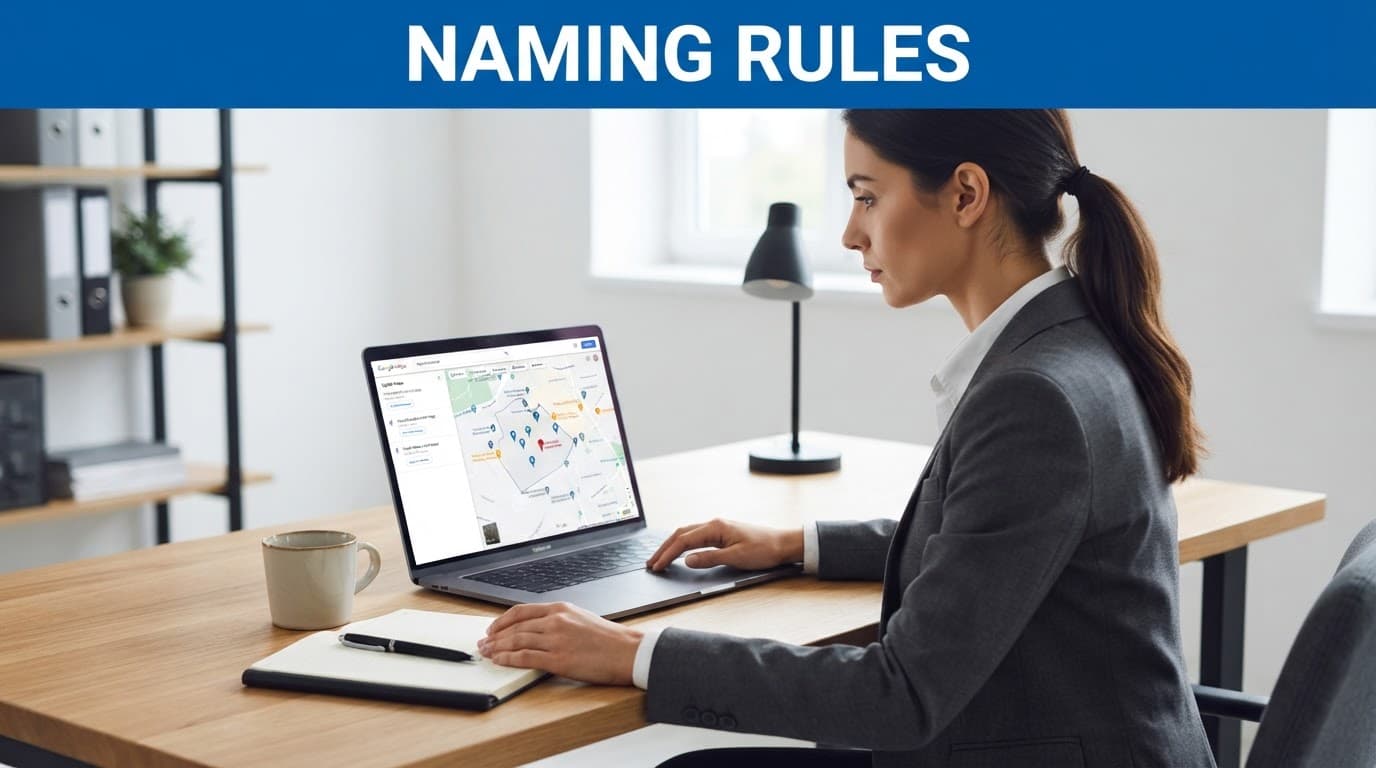
The profile name should identify the company, not act as a keyword list.
The same principle applies to rebranding. If the business has genuinely changed names, update the business name only when the underlying business remains the same. A completely new business should not inherit another company’s identity, customer reviews, or listing history.
Address and service-area rules are different
A storefront business should display the real street address of its physical location when customers visit there. Following address guidelines means keeping that address accurate, complete, and consistent with the company’s website and other trusted listings.
I never recommend using a P.O. box, private mailbox, coworking address, or virtual office as a substitute for an operating location. These addresses may look convenient, but they don’t prove that customers can find the business there.
Service-area businesses follow a different setup. Plumbers, electricians, mobile mechanics, cleaning companies, and similar providers can hide their home or office address when customers don’t visit them there. The profile should show the areas the business serves instead.
Google allows service areas based on cities, postal codes, and other defined areas. For service-area businesses, selected areas should stay reasonable and connected to the actual operating base. A company that works in Fort Myers and Cape Coral shouldn’t claim every city in Florida unless its operations genuinely support that reach.

Service areas should describe where the company can realistically provide service.
The service-area setting isn’t an advertising radius. It helps Google understand where the business operates. If the company expands, update the areas to reflect the change rather than adding distant locations in hopes of ranking there.
Categories, phone numbers, and websites need to match
Your primary category should describe what the business is, not every product or service it offers. I choose the most specific category among the available categories for the company’s main operation. Google’s quality guidelines call for an accurate match to the business’s main operation.
For example, a plumbing company should select the closest plumbing category. It can add relevant secondary categories for other substantial services when each one accurately describes the business. Categories shouldn’t become a list of every phrase a customer might search.
Locations in a chain offering the same service should generally use consistent categories. A location that provides a genuinely different service may need a different category, but the change should reflect a real operational difference.
The primary phone number should connect directly to the business or location. I avoid numbers that route customers through unrelated call centers, recorded menus with no useful path, or another company’s sales department. A local number is often helpful, but accuracy and direct connection matter most.
Use a website URL that leads to the actual business. For a service company, a specific service or location page can be more useful than a generic homepage when it directly matches the profile’s purpose and supports online bookings the business genuinely offers. I also compare the selected categories with the services shown on the website. The site should present matching business information, including the same business name, phone number, address or service area, and hours. A relevant Google Business Profile landing page can support both customer trust and consistent local information.
Descriptions and posts must stay factual
Google Business Profile policies expect the business description to explain what the company does, who it serves, and what makes its operation distinct. I keep the wording clear and useful instead of stuffing it with cities, repeated keywords, prices, promotions, or contact details.
Avoid claims customers can’t verify, such as guaranteed rankings, unbeatable prices, or suspicious superlatives. The business description should also exclude prohibited content, offensive or misleading material, irrelevant details, and promotional language reserved for an offer.
Public posts should meet the same quality guidelines. A post can announce changed business hours, including seasonal hours when genuine, explain a seasonal issue, share a useful customer notice, or direct people to a legitimate next step. I use Google Business Profile posts to support the profile, not to repeat keywords or create fake urgency.
Before publishing, check the contact details, offer details, dates, and landing page. Outdated information can frustrate customers even when the profile itself remains active.
Chains, departments, and individual practitioners follow special rules
Businesses with multiple locations should keep names consistent across chain locations in the same country, unless each location genuinely uses a different real-world business name. A location shouldn’t add a city name simply to distinguish itself in search.
If a site contains multiple brands, don’t combine every brand into one profile name. Select the brand that accurately represents the listed business. Virtual food brands operating from shared facilities still need to be evaluated separately under eligibility rules and shouldn’t be merged merely for visibility. Separate profiles may be appropriate when the businesses operate independently and meet Google’s eligibility standards. Profile management should stay with an authorized representative acting for a qualifying business.
Departments inside a larger organization may qualify for their own profiles when they have separate customer-facing entrances, distinct categories, and separate public contact paths. A department shouldn’t receive a separate listing only because it has a different internal team.
Individual practitioners, such as doctors, lawyers, dentists, insurance agents, and realtors, generally use their own first and last names. Credentials may be included when they are part of the accepted public presentation. The organization can have its own profile when it separately qualifies. When one practitioner is the only public-facing professional at a branded organization, Google may allow a combined brand and practitioner format.
A practical response to a suspended Business Profile
A suspension is frustrating, but repeated edits usually make the situation harder to diagnose. I start with the public listing and work inward rather than changing everything at once.
A verified profile can still fail review if its name, address, contact details, or website conflicts with the business’s other public details.
I use this sequence:
- I record the exact suspension message, profile URL, business name, and date. I also check whether the profile is suspended, disabled, missing from Maps, or simply ranking poorly. Those are different problems.
- I compare the profile with the business website, storefront sign, invoices, business registration, social profiles, and major directories. This helps confirm consistent business information across each source. Name, address, phone number, hours, website, and service area should tell the same story.
- I inspect the address first. If the company is a service-area business, I hide an address that customers don’t visit. If it has a storefront, I confirm that the location is staffed and properly identified.
- I remove keyword wording and duplicate profiles to follow Google’s quality guidelines, correct the primary and secondary categories, and check account access. I confirm that an authorized representative can access the Google Account managing the listing. Another owner, agency, public suggestion, or connected listing tool may be pushing old information back into the profile.
- I gather relevant evidence, such as business documents, current signage, branded vehicles, licenses, or official website details, for the verification process. I submit one clear appeal that explains the actual business model and the exact corrections made.
- I avoid creating a replacement profile while the original is under review. After submitting the appeal, I monitor the account and wait for the response instead of sending repeated forms every few hours.
Once the profile is restored, I perform a routine audit. I check the public listing monthly and review the full local presence at least twice a year, or after a move, rebrand, phone change, or service expansion. I also test the phone number, contact form, booking path, business hours, and important website links. A stale phone number can waste leads just as quickly as a suspension.
If your profile, website, and local listings tell conflicting stories, Contact Us for a practical review of the setup.
Frequently Asked Questions
Can I add a city or service keyword to my business name?
No. The profile name should match the name customers see in the real world, such as on signage, invoices, and the business website. Cities, services, phone numbers, and promotional phrases should be placed in the appropriate profile fields instead.
Does a service-area business need to display its address?
Not usually. If customers do not visit the business at its home or office address, the business should hide the address and list the realistic cities, postal codes, or areas it serves.
What should I do if my Google Business Profile is suspended?
First, identify the suspension type and compare the profile with the business’s website, signage, registration documents, and other listings. Correct inaccurate information, remove policy violations, gather relevant evidence, and submit one clear appeal rather than creating a duplicate profile.
Can a business have multiple Google Business Profiles?
Each eligible location should generally have one accurate profile, and duplicate listings should be removed or resolved. Separate profiles may be appropriate for independently operating brands, qualifying departments, or individual practitioners when they meet Google’s eligibility and representation rules.
Accurate details are the strongest protection
Google Business Profile rules are easier to follow when every field reflects how the business operates offline. Use the real name, a valid location or honest service area, the right category, a factual business description, direct contact details, and a website that confirms the same information.
For local businesses, I treat profile optimization as ongoing business information management, not a one-time form submission. When the business changes, update the profile, website, directories, and customer contact paths with it. That consistency gives customers a reliable listing and gives Google fewer reasons to question the business behind it.