

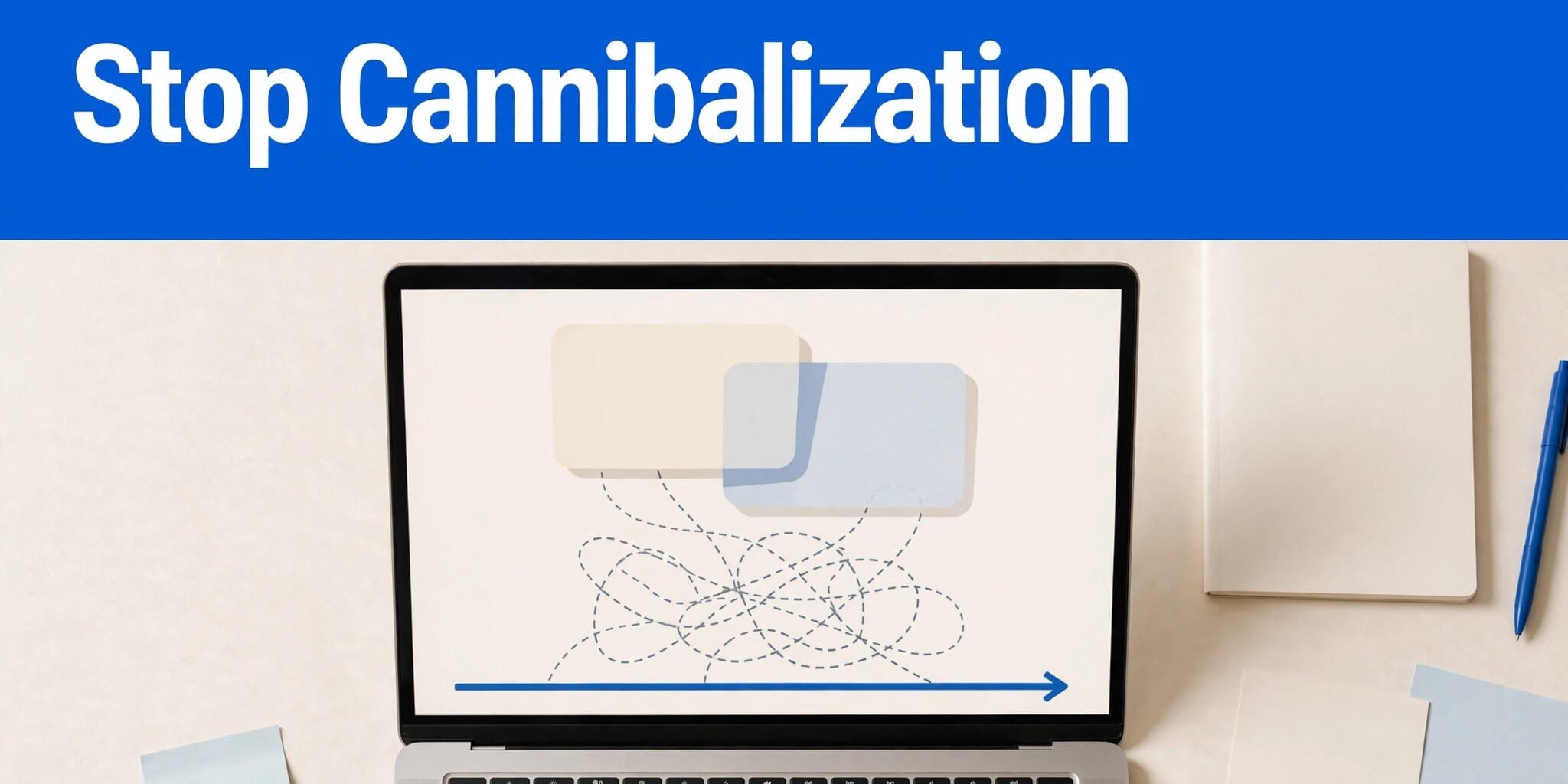
Two service pages can both look useful and still weaken each other in Google. Keyword cannibalization isn’t merely similar wording. It occurs when two URLs compete for the same customer and offer, leaving Google to decide which deserves to rank.
For a business owner, the cost isn’t only weaker search engine rankings. It can reduce search visibility and send a homeowner seeking emergency repairs to a broad maintenance page instead of the correct landing page. Valuable links can also split between two pages that should work together.
I prevent this problem by giving every important page one clear job, one primary intent, and a logical place in the site structure.
Key Takeaways
- Keyword cannibalization happens when two URLs target the same search intent, customer need, offer, and query set—not merely when they use related keywords.
- Give every important service page one clear purpose, primary topic, conversion goal, and boundary before publishing new content.
- Use Google Search Console, SERP reviews, position tracking, and conversion data to confirm whether pages are competing before changing or deleting URLs.
- Merge pages when one stronger URL can satisfy the same intent, differentiate pages when customer needs differ, and reserve canonical tags for genuine duplicates.
- Reinforce the preferred page with relevant internal links, consistent sitemap references, and regular audits of service, location, and programmatic pages.
What Keyword Cannibalization Looks Like on a Service Website
Keyword cannibalization is not simply two pages using a related phrase. Related phrases can appropriately lead to separate pages when the audience, funnel stage, service, location, or pain point differs. The same applies when the conversion or expected page experience changes.
It becomes a problem when two URLs serve the same search intent and target substantially the same need, offer, and query set. Similar copy and competing calls to action make the overlap even clearer.
For example, an HVAC company might have pages for “AC repair in Fort Myers,” “air conditioning repair,” and “emergency AC service.” Those pages can coexist if each has a distinct purpose. Trouble starts when all three use the same copy, offer the same repair service, and target the same local terms.
Similar keywords can still have different intent
A customer searching “AC repair Fort Myers” usually needs a repair company now. Someone searching “AC maintenance plans” is comparing recurring service options. The terms share a topic, but their search intent calls for different pages.
I look at the desired conversion first. If the business needs repair calls, the repair page should lead with repair service, local proof, response expectations, and a clear contact option. A maintenance page should focus on tune-ups, plan details, and scheduling.
This same rule applies to title tags. A title such as “AC Repair, Installation, Duct Cleaning, Maintenance, Cooling Service in Fort Myers” is hard to scan and may read like keyword stuffing. Give the page one leading service for clarity, then add the brand only if it fits naturally.
Content overlap is the larger issue
Content cannibalization often sits behind the keyword problem. Pages may have different titles but repeat the same headings, service descriptions, testimonials, and calls to action.
That repeated structure is content cannibalization when the pages also compete for the same need. Substantial duplicate content is stronger evidence than simply sharing service terminology.
Google can index both URLs, but appearing at the same time for related terms isn’t proof by itself. Confirm the problem through repeated URL switching in the search results, a shared search query, and similar SERP intent. Also check whether customers reach the wrong service.
Rankings fluctuate, links divide, and neither page builds a strong identity. That is why I review page purpose before I start changing keywords.
Multiple pages can rank for a related query when they meet different needs. The problem begins when they compete to be the same answer.
Build a Keyword Map Before Publishing Service Pages
A keyword map records which page owns each meaningful topic. It stops new content from duplicating a page that already has a valid job.
Keyword mapping assigns one primary topic to each page, based on revenue potential, customer need, and page purpose.
For local businesses, I start with actual revenue-producing services, not a long list of broad phrases. Then I group closely related terms beneath the page that owns them.
Close variations and long-tail keywords usually belong on that same page, rather than spawning unnecessary URLs.
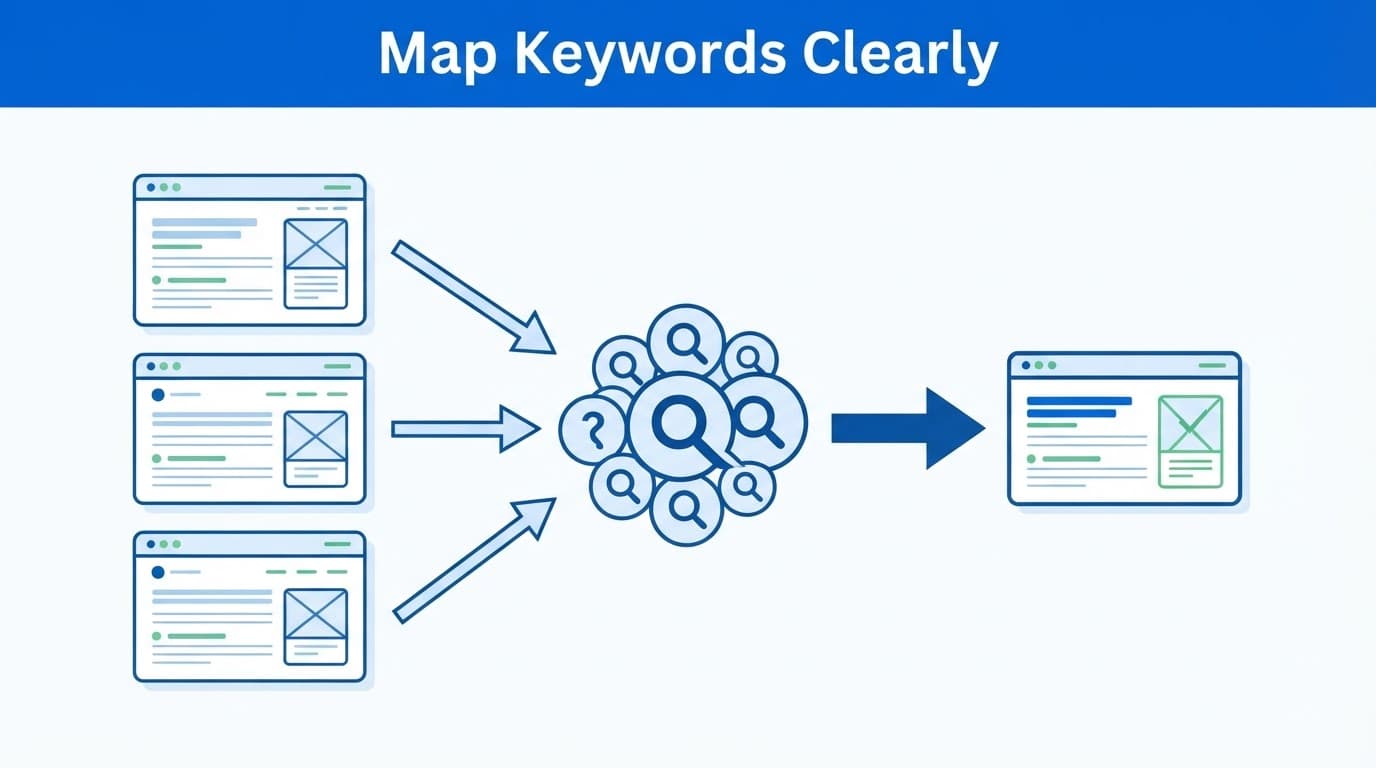
Start with the page’s conversion goal
Each row should record the URL, page type, service, and location. Add the primary topic, audience or problem, conversion goal, supporting terms, internal-link destination, and boundary.
Use search intent to classify each page as service, informational, local, or transactional. A short structure is enough:
This short mapping template makes ownership easy to review before publishing:
| URL | Page type | Service | Location | Primary topic | Target keyword | Search intent | Audience/problem | Conversion goal | Supporting terms | Internal-link destination | Does not cover |
|---|---|---|---|---|---|---|---|---|---|---|---|
| [page URL] | Service | [service] | [location] | [topic] | [primary phrase] | [service, informational, local, or transactional] | [customer need] | [desired action] | [close variations] | [owning page] | [related topics handled elsewhere] |
A practical HVAC example might look like this:
| Page | URL | Primary intent | Main action | Does not cover |
|---|---|---|---|---|
| AC repair page | [existing AC repair URL] | Urgent repair request | Call or request service | Installation or maintenance |
| AC installation page | [existing AC installation URL] | Replacement estimate | Schedule an estimate | Repairs or maintenance |
| Maintenance plan page | [existing maintenance plan URL] | Recurring preventative care | Review plans or enroll | Urgent repairs or replacement estimates |
This approach prevents a repair page from slowly becoming a catch-all page for every HVAC keyword. It also helps writers avoid repeating the same title, H1, and opening copy across the site.
It gives the content strategy a clear rule: create a new page only when the service has real demand and a distinct purpose. Secondary topics should point through internal links to the page that owns them.
For location-based businesses, keyword mapping for local SEO should reflect real service areas and real customer demand. Creating a nearly identical page for every nearby town rarely gives customers a better answer.
Define boundaries before writing
I add a brief “does not cover” note to every page in the map. An installation page may mention repairs and maintenance, but it should link to those pages instead of trying to rank for every service.
This boundary matters when teams add pages over time. A new page called “Residential Plumbing Services” may overlap with existing pages for drain cleaning, leak repair, water heaters, and repiping. It may work better as a hub that introduces each specialty and directs visitors to the dedicated service pages.
Audit Existing Pages for Search Intent Conflicts
A content audit turns vague ranking concerns into decisions about URLs, keyword cannibalization, and SEO performance. I inventory service and location URLs, then export query and page data. I group overlapping queries by search intent, then compare the related pages’ copy, offers, titles, internal links, leads, and conversions.
A page with little organic traffic can still matter. It may have a valuable backlink profile, support the target keyword, or answer a question sales staff hear every week.
Use Google Search Console to spot overlap
In Google Search Console, I filter the Performance report by page and search query. I export clicks, impressions, CTR, and average position for each URL, then compare the pattern over time. Position tracking helps me spot persistent URL switching, while ranking history adds context beyond a single daily change.
These patterns need a closer look:
- The same search query produces impressions for two service pages, so I compare clicks and position consistency.
- Position tracking shows whether two URLs trade positions for a high-value query over several weeks.
- A broad service page gets impressions for a specific service it barely explains.
- The URL intended for the target keyword has impressions but few clicks, while another page attracts the traffic.
- Impressions for two URLs alone don’t prove keyword cannibalization. I require substantial intent overlap and a meaningful business consequence before calling it a problem.
I use Google Search Console for local SEO to review clicks, impressions, CTR, and queries together. These metrics show whether the right URL supports the customer’s next step better than rankings alone.

Compare pages as a customer would
Next, I inspect the live SERPs and use a site search for site:yourdomain.com service name to find likely competing URLs. I open those search results and read each page’s first screen without focusing on SEO details.
Can you tell what makes one page different from the other? Do both pages target the same location, promote the same offer, and ask for the same conversion? During this content audit, different search intent signals intentional overlap, while shared needs and business consequences signal problematic content cannibalization.
I also compare title tags and page language. A clear title should state the service, location when appropriate, and business name without cramming in every related phrase. Google may rewrite unclear titles, so focused language helps confirm the preferred URL before I choose a remedy.
Choose the Right Fix for Competing Service Pages
The right fix depends on whether one page should disappear, both need clearer roles, or the URLs contain substantially the same duplicate content. I never delete a page before checking its traffic, leads, backlinks, indexed queries, and business value.
Use this framework for keyword cannibalization. Consolidate when pages share the same search intent and offer, and one URL is clearly stronger. Rewrite when both pages have valid but unclear roles. Differentiate them when the services or customer tasks differ. Leave pages unchanged when the overlap is intentional and performance, conversions, and SERP evidence show no harm.
Keyword cannibalization isn’t automatically a problem. Don’t change pages without evidence that one URL is weakening the other.
When selecting the surviving URL, compare organic traffic, backlink profile, page authority, and position tracking. No single metric determines the decision, so also review conversions, indexed queries, and business value.
Merge pages when one resource can do the job
When two pages serve the same search intent, choose the stronger URL as the primary page. Move useful details from the weaker page into it, including relevant FAQs, project examples, service explanations, and long-tail keywords customers use.
Then implement 301 redirects for the retired URL, pointing it to the consolidated page. A 301 tells browsers and search engines about a permanent move. It can help align ranking signals, but it doesn’t guarantee every signal transfers.
During redirect testing, verify that the 301 redirects resolve correctly and send users to a relevant destination. After publication, validate the preferred URL in search results and confirm the landing page still matches the user’s original task.
Before publishing, update internal links, navigation, XML sitemaps, and paid campaign URLs. Review the old page’s backlinks and anchor text, too. A valuable external link should lead to the closest relevant replacement, not the homepage.
Differentiate pages that meet separate needs
Keep both pages when the services or customer tasks differ. Rewrite the title tag, H1, first paragraph, supporting sections, images, and calls to action so each page serves a defined audience and task.
For instance, a roofing company can maintain separate pages for roof repair and roof replacement. The repair page should address leaks, storm damage, and patching. The replacement page should explain material options, inspections, financing where applicable, and estimate requests.
The service pages that generate leads approach works best when each page answers a specific buyer question rather than repeating broad promises.
Use canonical tags only for genuine duplicates
Use canonical tags when near-identical versions must remain available, such as filtered product URLs or tracked campaign parameters. They’re appropriate for genuine duplicate or parameterized URLs, not as a shortcut for distinct service pages.
Google explains that canonicalization helps consolidate duplicate URLs, but treats canonicals as signals rather than commands. If a page has a self-serving canonical but every internal link points somewhere else, the site sends mixed messages.
Reinforce the Preferred Page With Internal Links
Internal links tell visitors and crawlers which pages matter and how they relate. After merging pages, update internal links so every relevant reference points to the surviving URL. This prevents keyword cannibalization, reduces redirect chains, protects crawl budget, and makes important URLs easier to discover.
Descriptive anchor text works better than vague phrases, and varied wording reads more naturally. A water heater post can link to “water heater repair”; a maintenance page can use “emergency AC repair” when helpful. Contextual internal links should point to a destination only when it satisfies the visitor’s search intent. Don’t force the same anchor text into every link.
Google’s guidance also recommends using the preferred URL consistently in site references and XML sitemaps. This canonical URL reference reinforces the practical rule: sitemap consistency supports URL clarity, but it doesn’t replace relevant internal-link choices.
I review the homepage first because it often links to broad services. I then check navigation, relevant blog posts, location pages, FAQs, and related service pages for relevant references to the preferred URL. Prioritize strong, relevant sources for page authority and consistent ranking signals.
Each core service page should use internal links to connect with related FAQs, location information, reviews, and the contact path. Don’t link every service page to every other page. Use position tracking to check whether the preferred page gains the intended query coverage.
Handle Location Pages and Large Service Catalogs Carefully
Location pages are common sources of keyword cannibalization. A plumber may create a “plumber in Cape Coral” page, then publish separate city pages that repeat the same service paragraph with only the place name changed. This pattern creates content cannibalization and duplicate content, allowing near-identical city and service combinations to compete.
Each indexable location URL needs a genuine reason to exist and a clear search intent. Add useful local details, accurate service availability, unique project proof when available, and clear contact information. Use internal links to connect location hubs with the real service pages. If a page can’t offer distinct customer value, consolidate the service area instead of cloning it. A quality gate should guide these decisions, rather than encourage mass deletion without evidence.
Keep programmatic pages under control
Large catalogs can create thousands of URL combinations for services, cities, products, or category filters. Uncontrolled combinations consume crawl budget and can fill the index with weak variations. Before allowing those pages into Google’s index, decide which combinations match real demand and provide useful content.
I set rules for templates before publishing them. Each indexed page needs a unique purpose, an accurate title, a clear URL, and links that fit the site’s hierarchy. Use canonical tags only for genuine duplicate or parameterized variants, not for unique pages with different intent. Empty city templates, duplicate filters, and pages that show no results may need noindex tags when appropriate. Noindex isn’t a substitute for deciding which pages deserve to exist. These indexation rules protect crawl budget, and the team should monitor whether low-value URLs are being crawled so crawl budget stays focused on useful pages.
AI search tools also reward clear source pages. If three internal URLs make the same claim about one service, your site offers a weaker citation target. One complete, well-supported page gives search engines and AI systems a clearer source to reference.
Make Cannibalization Prevention Part of Ongoing SEO
Keyword cannibalization can return when new services, blogs, and location pages go live without a map. I use a quick pre-publication checklist. I run a quick site: check through site search. I review content cannibalization and identify the page that already owns the topic. I ask whether the new page serves a distinct need based on search intent. Then I decide whether it needs a page, section, or FAQ, and update internal links before launch. This keeps the page map aligned with the content strategy as services expand.
A quarterly content audit is enough for many small businesses. Review sooner after a redesign, service expansion, URL change, or major content campaign. Use Google Search Console for recurring query-to-page reviews, and set up position tracking after launches or URL changes. Record the baseline URL, query, clicks, conversions, and page role. At each quarterly review, revisit position tracking and broader search visibility. Wait for enough data before changing a page; not every ranking fluctuation requires a rewrite.
Organic SEO services should include this maintenance because SEO performance can drift as pages accumulate. Use the data to guide search engine optimization, rather than rewriting pages after every short-term fluctuation.
If your site already has competing service pages and you need a clear cleanup plan, Contact Us for a website and SEO consultation.
Frequently Asked Questions
What is keyword cannibalization?
Keyword cannibalization occurs when multiple URLs compete to answer the same search intent and serve the same customer need. It can split ranking signals, cause URL switching, and send visitors to a less relevant page.
Are similar keywords always a problem?
No. Separate pages can rank for related terms when they serve different audiences, funnel stages, services, locations, or customer tasks. The problem is substantial intent and offer overlap, not shared terminology alone.
How can I identify keyword cannibalization?
Use Google Search Console to compare queries, clicks, impressions, CTR, and positions across URLs. Then review the live SERPs, page copy, offers, calls to action, and conversion data for repeated URL switching and shared intent.
Should I use a canonical tag on competing service pages?
Canonical tags are best for genuine duplicates, parameterized URLs, and near-identical versions that must remain available. They are not a shortcut for distinct service pages with different search intent.
When should I merge or rewrite competing pages?
Merge pages when they serve the same intent and offer and one URL is clearly stronger, using a relevant 301 redirect after consolidation. Rewrite or differentiate both pages when they meet separate customer needs but their titles, copy, and calls to action are unclear.
Final Thoughts
A clear service-page structure reduces keyword cannibalization and gives customers a faster path to the service they need. As a default, use one focused page per distinct intent, supported by useful internal links and specific, trustworthy copy.
Intentional overlap can still work when pages serve different users or tasks. Let performance and conversions guide audits, redirects, and technical signals, rather than fear of similar words, so your search engine rankings remain easier to manage.