

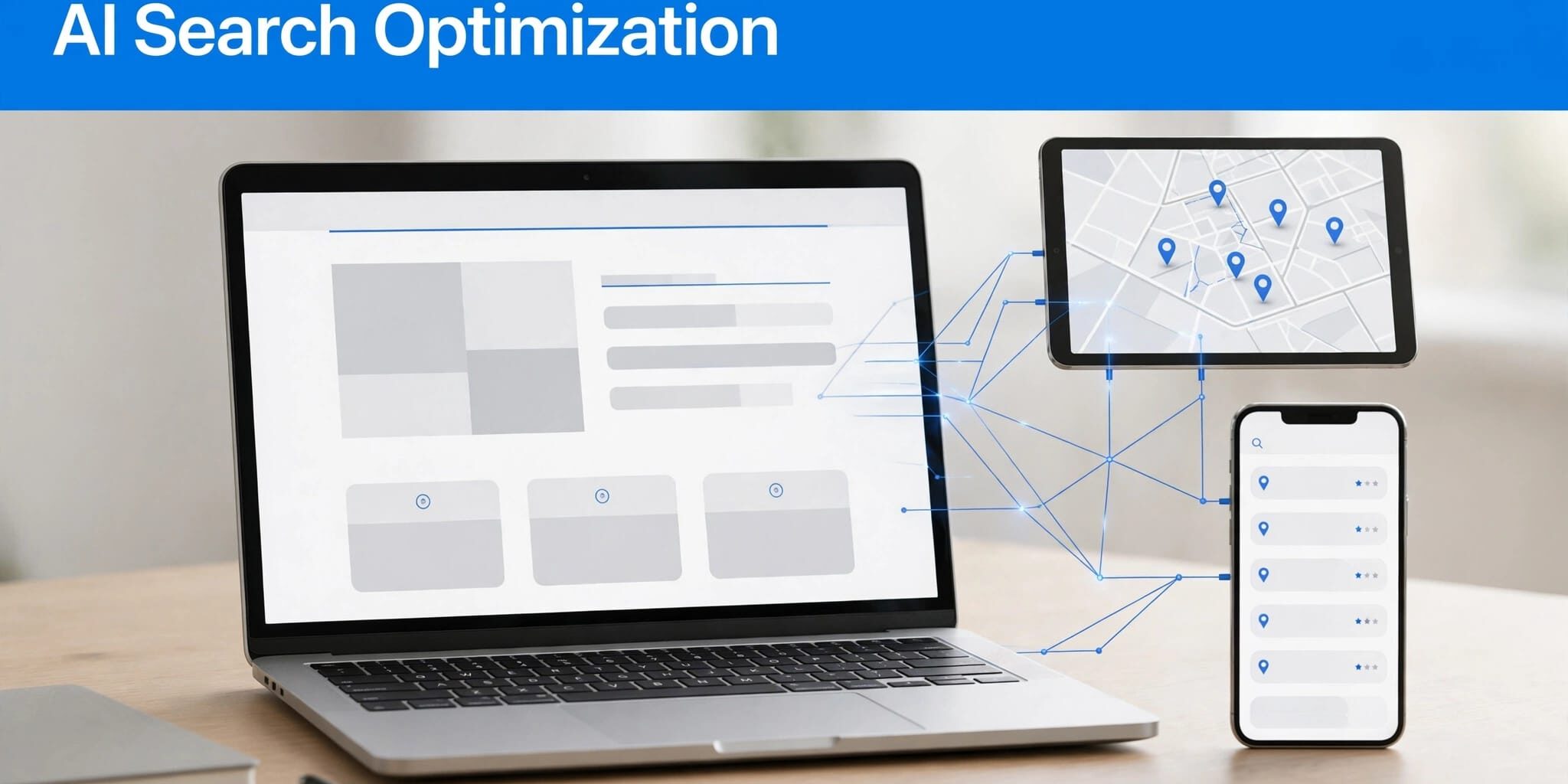
Your website can look polished and still leave AI search tools guessing about what your business does. I approach AI search optimization by making the site easy to verify, with clear services, accurate local details, and pages search systems can access.
Accurate local facts support digital marketing and search visibility across Google AI Overviews, ChatGPT, Microsoft Copilot, and Perplexity AI. However, no formatting trick guarantees a citation.
I start with access and accuracy, then improve the answers customers need before they call.
How AI Search Optimization Differs From Traditional SEO
Traditional search engine optimization helps pages appear on search results pages through ranking algorithms and semantic relevance. AI search systems also need to retrieve, understand, and reference page information in generated answers.
Artificial intelligence, including generative AI and large language models, may draw on several sources to produce answers. Some systems use natural language processing and machine learning to interpret queries and content, though methods vary by platform.
For Google AI features, a supporting page must be indexed and eligible to display a Search snippet. Eligibility doesn’t guarantee selection.
I therefore treat AI visibility as an extension of sound SEO. Clear titles, useful internal links, reliable business information, and helpful content remain the foundation.
A citation also needs interpretation. An answer might reference your pricing explanation without recommending your company. Meanwhile, a recommendation might point to a directory rather than your website.
The practical goal is to give search systems a dependable source while helping visitors decide whether your business meets their needs.
Fix Crawl Access Before Rewriting Pages
I check whether search systems can reach important pages as part of technical SEO, before investing in new copy. A blocked service page can’t benefit fully from better wording.
Check indexing and rendered content
Start with your homepage, primary service pages, and genuine location pages. Each should return a successful response, have an appropriate canonical URL, and avoid unintended noindex directives.
Then inspect the page in Google Search Console. Compare the rendered content with what a visitor sees.
Important information shouldn’t exist only inside an image, a booking widget, or content that appears after a button click. Put service descriptions, coverage details, and contact information in accessible page text.
Although Google can render JavaScript, other retrieval systems may handle it differently. Server-delivered HTML provides a more dependable starting point.
I also review ordinary internal links and the XML sitemap. Correct robots.txt rules for service pages help preserve access to lead-generating URLs.
Separate search crawlers from training crawlers
OpenAI uses different controls for search and potential model training. According to OpenAI’s crawler documentation, OAI-SearchBot supports ChatGPT search, while GPTBot concerns training crawls.
You can allow the search crawler while restricting GPTBot. Don’t assume one setting controls both.
Perplexity AI has its own access rules through PerplexityBot. In addition, hosting security tools can block crawlers even when robots.txt allows them.
Ask your developer to check firewall challenges, response codes, and server logs. A permitted crawler receiving an access-denied response still has a problem.
Make Local Business Facts Easy to Verify
Conflicting details create uncertainty for customers and search systems. I establish one current set of business facts before expanding content. Clear, consistent information also supports AI search optimization.
Align identity, hours, and service areas
For local SEO, keep your business name, phone number, published address, hours, and website consistent across your site, Google Business Profile, and important directories.
For service-area businesses, clarify where you operate and where customers can visit. Serving Lehigh Acres doesn’t mean you have a public office there.
If you hide a residential address on your business profile, don’t publish it elsewhere just to fill a template.
Describe your coverage accurately, too. City names alone don’t explain appointment availability, travel limits, or whether every service reaches every listed area.
Update these details when operations change, rather than waiting for the next website redesign.
Use schema to describe visible facts
I use structured data to identify the business and connect its services to that identity. Appropriate types include LocalBusiness, Service, and PostalAddress.
Use accurate opening hours and location details. For multiple branches, give each real location its own information instead of copying one branch’s markup everywhere.
Your approach to local schema markup for services should match the visible page content.
Validate syntax with Schema Markup Validator. Use Google’s Rich Results Test to check for supported Google search features.
However, Google’s guidance for AI features says no special AI schema is required. Valid markup clarifies information, but it doesn’t guarantee citations or enhanced search results.
Write Service Pages That Answer Customer Questions
I want each important service page to answer the questions that determine whether someone contacts the business. Generic claims about quality rarely provide enough detail.
Give direct answers under descriptive headings
Use headings that identify the question or subject. “Service Areas” and “What an Inspection Includes” communicate more than “Our Commitment.”
Under each heading, lead with a complete answer. Then explain conditions, exclusions, or supporting details.
If you publish prices, distinguish a starting price from a fixed quote. Explain what changes the cost. Likewise, describe appointment availability truthfully instead of implying immediate service everywhere.
Questions from calls, estimate requests, and sales conversations are useful starting points. “Do you serve Lehigh Acres?” belongs on the relevant service page when you can answer it accurately. Clear answers also suit voice search, without requiring a separate page.
I also use on-page optimization to keep title tags, the main heading, and page content aligned. A page promising repairs shouldn’t mainly discuss replacements.
Give each topic a clear primary page
Before adding another article, check whether an existing page already answers the same need. Keyword research and search intent can guide content creation around distinct customer questions. Several overlapping pages make maintenance harder and can create conflicting claims.
I prefer one complete service page with supporting articles that answer distinct questions. A clear content strategy keeps those articles organized around the service page, while descriptive links help connect them as part of broader digital marketing.
Location pages need a separate reason to exist. Real project history, branch details, or area-specific service conditions can justify one and support local SEO.
Changing only a city name across dozens of pages adds little useful information.
Finally, use lists or tables when customers need to compare options. Formatting should clarify the decision, rather than turn every paragraph into a collection of disconnected snippets.
Support Claims With Genuine Local Evidence
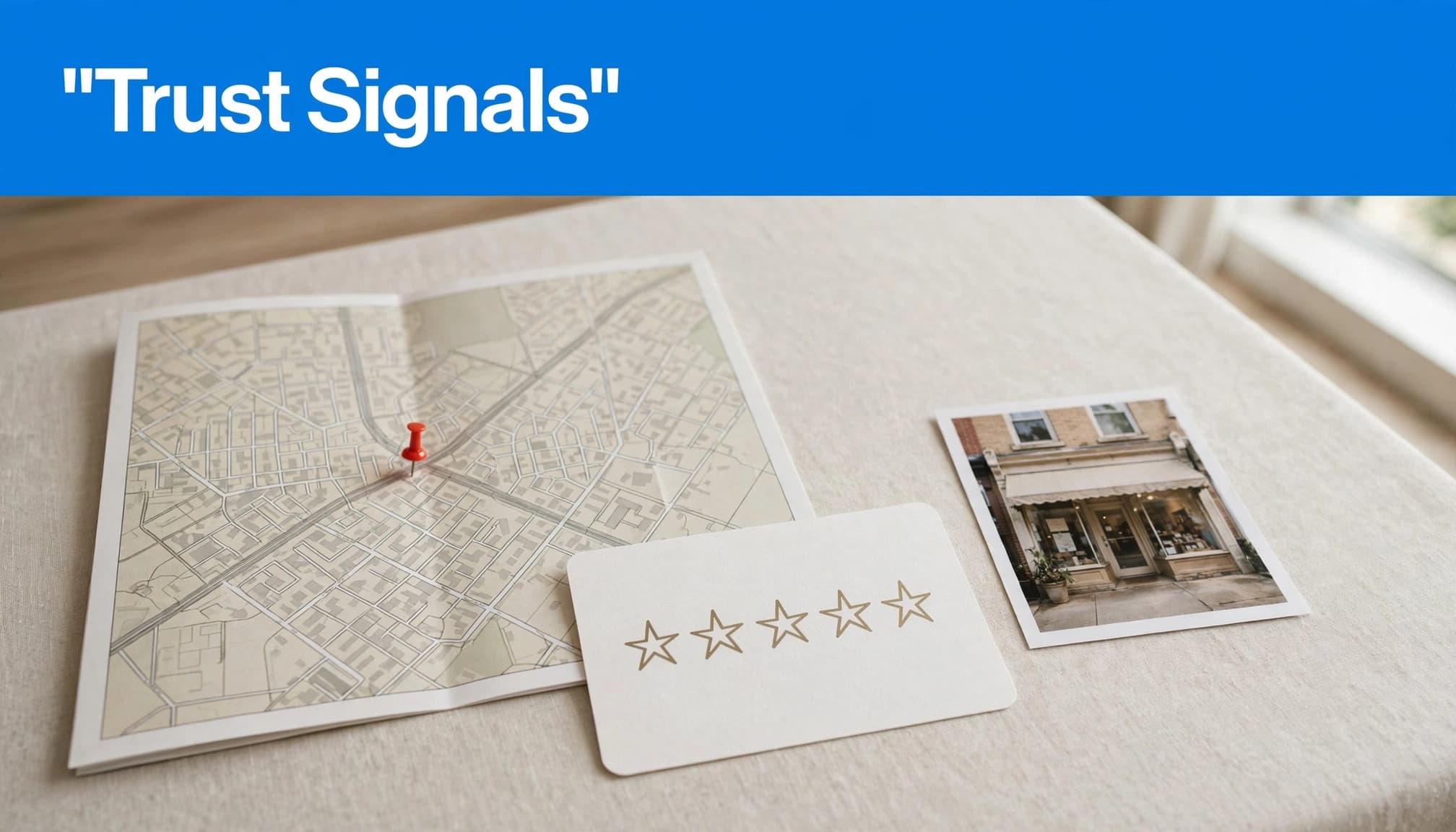
I look for evidence a customer can evaluate: named qualifications, accurate licensing information where relevant, real project photos, and clear descriptions of completed work.
Explain who performed the work and what the service involved. Get permission before publishing customer details or identifiable photos.
Original visuals can document experience, but important facts still need readable text. Add useful alt text to images and a transcript or summary for videos.
A photo of a finished installation becomes more informative when the page explains the work performed. Don’t invent a location or outcome to make the caption sound local.
Reviews and independent mentions provide social proof and additional context. Keep listings accurate, request genuine feedback, and respond professionally so readers can assess that social proof. Neither review volume nor social media activity guarantees an AI citation.
For technical or regulated services, identify who reviewed the content and provide relevant credentials. This gives readers a way to assess the advice.
Put changing business facts on pages you control. An old directory listing shouldn’t be the clearest available source for your current hours or service coverage.
Freshness matters when information changes. Update the underlying facts, not merely the publication date.
Measure Citations Separately From Traffic and Leads
AI search optimization needs several measurements because citations, AI referral visits, organic traffic, and inquiries describe different outcomes. For digital marketing reporting, I avoid treating any one metric as proof of business growth.
Track source visibility and answer accuracy
Bing Webmaster Tools introduced its AI Performance public preview in February 2026. It reports citations across Microsoft Copilot, AI-generated Bing summaries, and selected partner integrations.
The reporting includes citation totals and cited pages. These counts measure references, not rankings or authority.
For manual checks, test three to five query variations across your service area. Include branded searches, service questions, neighborhood-specific needs, and relevant voice search phrasing.
Record the date, platform, exact prompt, location context, cited URL, and answer accuracy. Because generated answers can vary, repeat checks before declaring a trend.
I pay particular attention to incorrect hours, unsupported availability claims, and references to outdated pages.
Connect visits with meaningful contact actions
In Google Analytics 4, review referral sources such as ChatGPT and Perplexity AI when that information is available. Compare those visits with organic traffic, but neither source provides a complete citation count.
Track successful form submissions, appointment bookings, and phone-link clicks to assess conversion rates. A phone click alone doesn’t prove a completed call.
Google includes AI-feature traffic within overall Web reporting in Search Console. It doesn’t provide a simple separate AI Overviews traffic report.
Use Search Console for local SEO alongside analytics and actual lead records.
Review user behavior around contact actions, then test the mobile contact path yourself. A citation has limited value when the destination has a broken form or an unusable phone button.
Key Takeaways for a Practical Starting Plan
I prioritize improvements by their effect on access, accuracy, and customer decisions. You don’t need to rebuild every page at once.
- Check your homepage and highest-value service pages for indexing problems, blocked crawlers, and missing readable content.
- For local SEO, reconcile business details across your website, Google Business Profile, and important listings. Then correct matching structured data.
- Improve one priority service page with on-page optimization, direct answers, local evidence, and customer reviews that provide social proof. Check that its mobile contact path works.
- Record a search visibility baseline and monitor citations, referral visits, and qualified inquiries separately.
This order helps protect the budget. Publishing more content won’t resolve an access problem, and attracting more visits won’t repair an unreliable form.
Frequently Asked Questions
Is an llms.txt file required for AI citations?
Google’s AI-feature guidance doesn’t require an llms.txt file. I wouldn’t put it ahead of indexing, crawl access, clear service content, or accurate business details.
If you experiment with one, treat it as an optional addition. It shouldn’t replace your sitemap, internal links, or ordinary website content. Also, keep any listed URLs current so the file doesn’t point systems toward deleted or outdated pages.
How long does it take to appear in AI answers?
There isn’t a dependable timeline. Google says recrawling and processing changes can take several days to several months, and processing doesn’t guarantee selection.
Competition, existing website strength, and information quality also affect the work required. I monitor whether pages become accessible and accurate first. Then I look for repeated citations and qualified inquiries over time, rather than promising a deadline based on one successful test.
Build a Website Worth Referencing
I focus on dependable source pages: accessible content, accurate local facts, and answers supported by real business evidence and social proof. These digital marketing improvements help customers even when an AI platform doesn’t cite your site.
Start with the service page most important to your business and correct its weakest points.
Acts 17:11 (Amplified Bible) offers a useful prompt: How carefully do you verify the business facts you publish?
For a free consultation about your website and SEO needs, Contact Us. DMNet Solutions can help you prioritize practical improvements without treating AI visibility as a guaranteed result.