

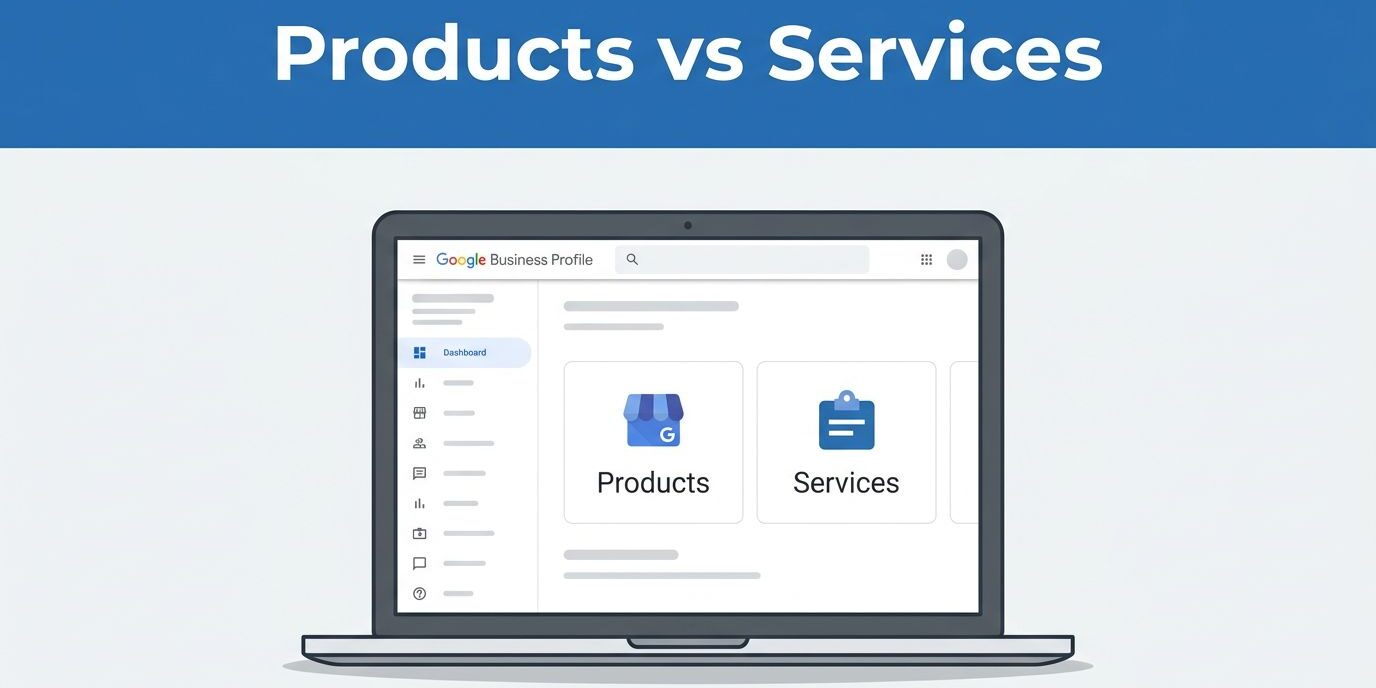
Navigating the nuances of GBP products vs services might seem like a minor setup detail, but this decision fundamentally changes how potential customers interact with your listing. When a business profile feels vague or disorganized, these specific settings are often where the problem starts. Mastering your GBP products vs services strategy is a foundational step in effective local SEO.
I approach this by asking one simple question first. Am I selling a tangible item that a customer can hold, or am I selling professional work that I perform? That answer dictates what belongs in the Products section, what belongs in Services, and how well your profile aligns with the specific search queries that brought someone to your page. Getting this right is a critical part of professional GBP optimization, as it ensures your business is accurately represented to the local audience you are trying to reach.
Key Takeaways
- Distinguish by Intent: Products are for physical, tangible items customers can purchase and take with them, whereas Services are for professional tasks, repairs, or consulting work you are hired to perform.
- Prioritize Relevance: Focus your profile on the specific tasks or items you offer; using precise, high-intent language helps Google better match your listing to relevant local search queries.
- Ensure Cross-Platform Consistency: Your Google Business Profile must mirror the terminology and service offerings found on your official company website to avoid confusing search engines and potential clients.
- Quality Over Quantity: Avoid stuffing your profile with irrelevant entries. A shorter, clear list of high-intent services or products drives better engagement and trust than a long, disorganized list.
- Maintain Accuracy: Regularly audit your profile to ensure prices, product availability, and service descriptions are current, as outdated information damages user trust and local SEO performance.
What I mean by products vs services in Google Business Profile
This is the clearest way I separate them to maximize your visibility.
| Area | Products | Services | What it means for local SEO |
|---|---|---|---|
| What they describe | Physical items a customer can buy | Work a customer hires me to do | The right field makes the profile easier to understand |
| Where they show up | Google Search and the Products tab | Google Maps and Google Search | Visibility improves when the listing matches intent |
| Best fit | Retail, showrooms, restaurants with real items, mixed sellers | Plumbers, cleaners, consultants, installers, repair businesses | Relevance gets stronger when the label fits the offer |
| SEO value | Helps clicks and browsing | Helps Google read the exact service line | Neither one is magic, but both can support stronger local SEO signals |
I don’t use the Products section as a shortcut for services. Google wants each field to describe the business honestly, and the cleaner the match, the easier it is for a customer to understand what I do. It is important to remember that your primary category dictates how these sections appear to potential customers. When you clearly define your offerings, you strengthen your business listing and ensure your expertise aligns with what users are searching for in your area.

If I had to choose one section for a service business, I would start with Services. It gives Google a sharper read on the work I actually perform.
When I use products on a profile
I use the Products feature when a customer can buy or view a physical item. This is ideal for equipment, replacement parts, branded packages, or retail goods that the buyer takes home. If I am listing a projector, a smart thermostat, or a physical accessory, the Product Editor is the tool I use to manage the inventory within the Google Business Profile.
That section works well for businesses that want people to browse before they call. By building a clear product catalog, you allow customers to scan your offers, compare options, and decide if your store is worth a visit. In that sense, your products act like a compact, digital display shelf inside your profile.
To keep this section effective, I keep the names plain and the product description short. Every product image should be high quality and professional to keep the list attractive. I also ensure prices remain current, as a stale list hurts trust if a customer clicks through to find outdated information. If your inventory changes often, make sure to update it regularly or remove the item entirely.
For better performance tracking, I often add UTM tags to the links leading to a specific landing page on the company website. This allows me to measure how many people visit the site from the profile using Google Analytics. While these tools help with clarity, I do not treat them as a shortcut to higher rankings. Instead, they make the profile easier to shop, which leads to more clicks and better engagement for your local business.
Why services matter more for most local companies
Services are for the work I do, not the thing I sell. This includes installations, repairs, consulting, maintenance, cleanup, and other jobs a customer books.
For local service businesses, this section is vital because it tells Google exactly what a customer can hire me for. When you provide an exact service description for tasks like drain cleaning, TV mounting, or leak repair, you make it much easier for the algorithm to match your business to relevant queries. These specific listings can even appear as justifications within the Map Pack, which serves as a powerful signal to potential customers that you offer exactly what they need.
While filling out your services is not a direct ranking factor in the same way a primary category is, it acts as a critical conversion factor. People looking for one specific task are far more likely to choose a profile that spells out that task than one that hides it under a broad label. I see this as a trust issue as much as a search issue. Clear, honest language converts better, and using your Google Business Profile to be precise helps build that initial credibility.
Your primary category is the foundation here. Before adding items, I always check the primary category within the GBP dashboard to ensure the correct fields are available. Some categories open the services section while others do not. If your category is off, the rest of your setup will feel awkward, and your profile will send mixed signals to Google instead of effectively highlighting what you offer.
How I line up the profile with the website
Google compares your business listing with the company website, directory citations, and social media pages. If one source mentions a bathroom remodel while another highlights home renovation, I standardize the terminology so the same core message appears consistently across the web. This makes your brand easier for both potential clients and search engines to understand.
I also ensure service names mirror the terminology used on your site, particularly on your primary landing page. When the Google Business Profile uses different language than your website, the local signal becomes diluted. Your profile should not feel like a separate entity; rather, it should echo the specific offers found on your site, reinforced by positive customer reviews that confirm those same service claims.
That is why I pay attention to professional website maintenance and search optimization. Outdated pages, incorrect phone numbers, and mismatched service descriptions can muddy your local signals quickly. A high-performing profile works best when the website supports it with accurate, current information. I often implement UTM tags on links to ensure that we track traffic accuracy from the profile to the site, giving us a clear view of how users interact with your business.
Mobile search is a critical factor here, as most customers encounter your services on a phone long before they reach a desktop. Because mobile search behavior is so fast paced, your site must provide a seamless experience on small screens. If a page is difficult to navigate or slow to load, users will likely leave before calling. I have seen this happen frequently with local businesses that rely on consistent monthly leads to grow.
Common mistakes that weaken local visibility
I see the same mistakes over and over, and they slow down local growth. When it comes to effective GBP optimization, avoiding these errors is essential:
- Listing services as products makes the profile look tidy on the surface, but it sends the wrong signal to Google about your core offerings.
- Using vague names for your services, or hiding them within a generic business description, gives search engines very little context to work with.
- Letting the website and your Google Business Profile drift apart creates inconsistency that makes the business harder to trust.
- Adding too much at once, especially for multi-location brands, can make updates harder to review and manage within the GBP dashboard.
I also avoid stuffing the profile with entries no customer would search for. Ten clear, high-intent items always beat thirty fuzzy ones. When the wording matches the way a real customer talks, or mirrors the language found in positive customer reviews, I know the profile is on the right track.
For me, clarity is the key to driving better customer engagement. A local profile should help a potential client decide in seconds, not force them to decode the offer.
Frequently Asked Questions
Can I list my services in the Products section to get more visibility?
No, you should avoid listing services as products. Google’s algorithm expects these fields to describe your business honestly, and miscategorizing them sends mixed signals that can weaken your local SEO relevance.
How does the primary business category affect these sections?
Your primary category determines which fields are available and how they appear to users. It is essential to choose the most accurate category in your dashboard first, as it dictates the underlying structure for how your services or products are presented.
How often should I update my Products and Services sections?
You should update these sections whenever your offerings change or your inventory is updated. Stale information, such as outdated prices or discontinued services, harms your credibility and can lead to frustration when customers attempt to contact you.
Does adding Services directly improve my search ranking?
While adding services is not a direct ranking factor in the same way your primary category is, it acts as a powerful conversion signal. By clearly defining what you do, you make it easier for Google to associate your profile with specific search intents, which can improve your visibility in the Map Pack.
My bottom line for local businesses
My rule is simple. Products describe what customers can pick up, while services describe what they can hire me to do. For most local service businesses, services perform the heavy lifting because they align perfectly with search intent.
Products still provide value when you sell physical items or want to display a clear list of offers. The best strategy is to use both fields honestly, keep your wording concise, and ensure your information remains consistent across your website and other online listings. Your Google Business Profile serves as the face of your company, and maintaining a clean setup across the GBP dashboard ensures that you show up correctly on both Google Maps and Google Search.
Ultimately, trust is the primary conversion factor for local brands. If your profile and site do not tell a consistent story, Contact Us for a free consultation. A professional and accurate setup makes your business easier to trust, and that trust is exactly what turns a casual profile view into actual calls.